[I’ve been sitting on this for years. I’ve had a lot of bad years recently, we’ve all had. This novel has been gestating for decades–really. But sometimes, it’s hard to dream about a future if you don’t believe we have any future. I’m struggling to see past the narrow vision, or absence of one, in our tech brothers oligarchy or the presidency destroying us. We have to believe we’ll survive these bastards.
[I’m posting this section just to see if anyone thinks it’s worth pursuing. Comments are welcome and encouraged.
[This is an original work. No AI was involved in its creation.]
Poem: A CHILD’S SONG TO NYOKA
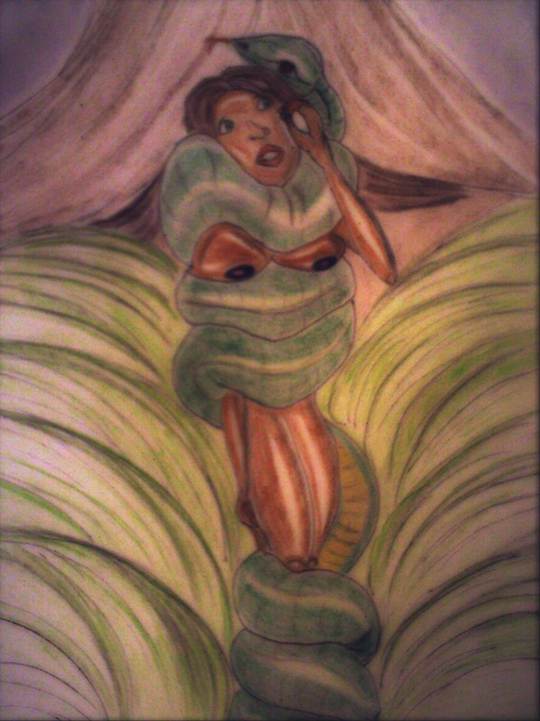
Oh wise Nyoka, may I nestle in your coils?
I have done a wicked thing
And I crave your indulgence
You sigh, little butterfly
What have I to do with thee?
For you are little and my hunger satiated
Why sleekest thou my embrace?
Oh wise python, may I sing of my sorrows?
I heard my friend call my name
And I behaved most shamefully
Sing on, sing on, sad child
You have aroused me at last
Thine heart is heavy, my blood cold
Bask on my scales and sing on, sing on
Wise Nyoka, cast your rainbow about me
The life of my friend is expired
And her spirit taken wing
Rest, rest, little child
For I perceive thy disparities
Thy skin is as the copper
Which flows through our soils
Thine emerald hued eyes glow with spirit power
Are we two not alike
We who embody the twin aspects of the other realm?
Thou art the light and I the darkness
Could the one be without the other?
Oh Nyoka, how thy skin ripples ‘gainst mine
Your coils are glossy and supple to the touch
Have your scales been born anew?
They have, they have, little butterfly
My old skin now basks on the summer stones
Soon the rains fall, lifting its colors from the dirt
And renewing the bow in the sky
But you grow still, little child
Thy limbs do not squirm so freely
Dost thou find my embrace too heavy to bear?
Dost thou fear me?
Oh grandfather of serpents, of you I have no fear
I have watched you in the twilight of the hunter’s stream
Clinging by my fingertips to the slippery stones
Wishing I could be your friend
For though I am small, I perceive that the same holds for you
Your giant brothers have all been forgotten
Except in rainbows and folklore
Alas, alas little spirit
Truly the days of my brothers are done
In this too we are allied
Both spirits shorn of relations
I of my brothers and you, your sister
Thou seekest counsel, warm skinned one
Such has been Man’s way in all the ages
From Natal to the shores of Delphi
I have counselled thy kind
What insights, pray tell, would I offer thee?
Oh Nyoka, my friend cried to me for shelter
But my foolish anxiety had undone her
Panic seized my heart and shut her from my thoughts
Listen, Nyoka! Even the drums condemn my trespass
My friend’s spirit has been cast away
And I know not where it has gone
Attend, attend little child
And heed, for what thou seekest is near
Search not the other realm
Mine eyes have beheld all its trespasses
Of thy spirit-kin I have seen none
Thy friend lives in spirit still
It is for thou to find her earthly vessel–
Ah! Thou squirmiest in me most pleasurably
Do you find my counsel not comfortable?
Oh wise python it is, but I am afraid
My strength is feeble, my inner sight poor
How can I accomplish this task?
You will try, little butterfly
Because you wish it–but not this night
Snuggle thyself tight, child, slumber in my blanket of coils
And we two will share thy warmth
Tonight the darkness and light are one
Dawn’s light shall find thee alone
But fear not
I will be near, to guide thee in thy quest
Though you see me not…
Prelude: RAW NERVE
The writer dropped everything when he received the cable. Laptop, medicine satchel all hit the mattress of his rented suite. The message was in the form of a text. Oddly enough it hadn’t come from Youssou but his uncle, Ismalla. Of course Jamai had sent him periodic updates, though recently at fewer and fewer intervals. He slumped onto the edge of the too-puffy mattress and re-read the message:
MADRID; JAMAI IN HOSPITAL. SITUATION CRITICAL. KEEP HER IN PRAYERS. YOUSSOU NOT WELL. ISMALLA
The second question he had after the state of Jamai’s condition, was how in the hell had they both gotten to Spain. What kind of adventures had she been dragged into this time? He hesitated a bit longer, concerned that this might be a bad time. Mutual sympathy and more than a little of his writer’s curiosity compelled him to make the call.
At first Youssou was unresponsive on his end of the connection. The writer tried twice more, and on the third try got his head bit off.
“What the hell do you want? I suppose you want the whole story, do you? Haven’t you done enough already?”
The writer was stunned into silence. Well, yes eventually he probably did. But he’s spent close to a decade getting to know her, digging into her past and yes he’d become a bit fond of them both, despite Youssou’s overprotective nature. Right now all he was concerned with was her safety–
“I can’t talk to you right now!” Youssou growled. “The doctor’s already beaten me. He thinks this is my fault!”
This? This what? What was happening–? He never got to ask those questions, never got one word in edgewise before Youssou shut him down.
Now that the connection was severed a part of him was livid. He wasn’t after another juicy scoop, he was only responding to a desperate call! How the hell was he supposed to know what’d been going on? Why hadn’t anybody told him they were in trouble?
Over the next couple of hours he talked the situation over with his editor and family. He’d invested not only a lot of time but a lot of himself in those two feisty Africans. Whatever slow boil was consuming Youssou, he couldn’t let this go.
The best advice anyone could give was patience. Standby but don’t contact them. This was a time for family to come together. When the time was right, they’d be sure to open up.
Fine advice, up to a point. Jamai didn’t have much family to pull around her. In fact her father was the one who’d exiled her in the mountains in the first place. By nightfall he was still in his newly wrinkled shirt, half-swallowed by the bed when Youssou called back.
He seemed very much contrite this time around. While only a couple of years has passed since the last time they’d talked, Youssou’s voice seemed ages older. He apologized for his emotional outburst. Jamai was still critical, they’d know more in a few hours, but he felt he owed the writer this much. He’d been a good friend for many years, Youssou said, and didn’t deserve his antipathy.
The writer assured him it wasn’t necessary, but Youssou couldn’t stop now. Whatever stress the pair of them had been through together had apparently been bottled away for a long time; he had to get it out. He didn’t know if another chance to talk would come. The writer didn’t understand; why “if” and not “when”? He resisted the instinct to grab pad and scribbler; it seemed far too cold and insensitive given Jamai’s condition. Then Youssou began the painful journey, explaining that for a long time he and Jamai hadn’t actually been together at all. As quietly as possible, while Youssou spoke, the writer gave in to instinct.
EXTRACT
Counseling Session
Location: Undisclosed
Subject: Goukoni Hadebe/ suicide watch
–You tried to commit suicide two nights ago, correct?
–No, not correct.
–You were discovered in your isolation cell hanging from your surveillance lens fixture, using a rope fashioned from strips of your own trousers. Must we confine you naked as well as alone?
–If you’d read any of my court transcripts, or any of the interrogation logs kept by the Rangers, you’d understand I was simply trying to connect with our Mistress.
–But, according to Interrogation Log 7, you are supposed to perceive the entity known as ‘Mistress’ as your ‘Mother’. ‘Mistress’ implies a sexual context.
–That is one interpretation. Another viewpoint is to conceive of her as our chief in exile, the agent on whose behalf we have operated.
–And where would this personage be today?
–Where? Where? Ha! If I knew that, would I have wasted my time feeding the unworthy to her?
–Your parents have expressed an interest in communicating with you periodically.
–I have no parents.
–Now that is not correct. DNA/RNA comparisons…
–They left me! I was abandoned in the Nairobi market and left to die!
–And who told you this?
–The Father, what others may call our Master, Bren Auflauring.
–He was the one who told you they hadn’t looked for you.
–Yes. Haven’t we gone over this before?
–Do you understand that this simply is not true? That they conducted a systematic search, ongoing for 19 months…
–Now, that is the lie! That was their intention, to leave me alone, trembling in the market, surrounding by shopping, screaming parasites.
–Would you accept the truth of what I have suggested, should I present the proof, search logs, diaries…
–All that can be fabricated. All of it obviously was, if you were stupid enough to be taken in by it.
–Would you be at all interested in establishing a communication with your brother?
–[static]
–Mr. Hadebe? Is that a no?
–I don’t know that he’d care to carry on such a dialogue. We parted on very strained feelings.
–If you’d allow, we can establish a format for dialogue. It will be under strict control. Restrictions will be applied as to the topics of conversation you will be allowed to pursue.
–Yes. Yes, I understand. I should like some time to consider.
–I understand. You may give me your answer at our next session.
SHE’S LEAVING HOME
One: Continental Drift
Jamai: The one hope I’d clung to throughout this whole unpleasant adventure was that I’d be able to reconcile with my father. That I could tell him I forgave him for what he’d done. How could he know I wouldn’t understand why he abandoned me in the mountains? How could he know that I’d be stupid enough to come home, that I’d kill those Poppy Girls…
Well, it didn’t matter. He wasn’t there and I didn’t see him. His possessions were either packed in our crawlspace or gone. Even our basement, which once overflowed with clutter, was a hollow shell. Only crickets skritched across the empty walls of our home.
Youssou’s lost brother had been behind everything, from the murder of Bren Auflauring to the kidnapping of Mama Hadebe to the murder of his sister Ahela. The Children of Sydelle had taken over an abandoned rock church in Gondar, Ethiopia. That little misadventure had cost me the second hand I’d lost in barely two years as well as the life of our local Magistrate Jomoro al-Amain.
I didn’t know of the bargain between Youssou and Jomoro. In exchange for liberating me from the Abyei-Bentiu prison barge, for what I then assumed was a temporary assignment, Youssou had essentially agreed to take me into exile, away from Baba Elgonyi forever.
Yousou’s father told us Mama Hadebe had commissioned two new holo-displays in our memories, one for Youssou and one for me to sit alongside Ahela’s holo on their bedroom mantle, so she could feel close to us even though we were gone.
I’d miss the Rangers. Though we’d only spent a few days rescuing Youssou’s mother from the Children of Sydelle, in the end I think they treated me as an honorary member.
At Captain Cobalt’s direction, we spent the next several days convalescing at a veteran’s hospital in Addis. I hadn’t told anyone about the fist that closed on my chest when Massoud poured through the breach. Or the shade leering down at me through the vision of Sydelle’s home sphere. It was probably nothing; it’d passed. Youssou’s family had already done so much for me. Why add any unneccesary worry?
Youssou was interned in the Ocular Ward, where they fitted him with a prosthetic eye. This was purely functional. It had no special abilities, apart from the perpetual glassy stare it projected, even when he was blinking normally.
As for me, it was a bit of a shock to us both when a party of bare-headed monks greeted us one fine morning. I was convalescing in my recovery room, my arm all swathed in wraps. In appearance, they were very much like the ghosts at Menes Tabot. My nurse flanked me as they unfolded a silk wrap from a box of exquisite wood. Holy symbols were carved in each corner, connected by swirling rosettes. The lid cranked open stiffly and lying inside, cushioned in red velvet, was a new prosthetic hand.
The epidermal covering was as supple as real tissue and even matched my dead mother’s Somali complexion. The lead priest explained that It had been handcrafted in the monks’ workshop in the Valley of Kings, in honor of my ‘purifying’ Menes Tabot. They had collected some of my stem cells from the Eukaryotic Cell Banks in Nairobi, with my father’s permission. That came as a great surprise to us both. Since the lab-grown tissue was essentially the same as mine, there would be little danger of tissue rejection.
An elderly monk with shriveled eyes, more of a dry husk than a man, smiled unnervingly as he lifted the instrument from the box. His little hands were quite warm as he unwrapped the bandages around my left wrist. He fitted the new member with a sharp ‘clack’ and stepped back as I tried to rotate it several degrees.
We all laughed as it did indeed rotate–360 degrees, and might have gone on doing so all day if I hadn’t slapped my right hand over it. “It will take some getting used to,” the old monk allowed.
Our final days mopping up at Menes Tabot were uneventful. While Youssou was being debriefed by Captain Cobalt, sometimes shouting, I stood in the mausoleum with the Rangers’ Medical Examiner as we removed the encapsulated bodies from their desecrated tombs.
I’d discovered late in our recent adventures that some of the bodies the COS had stored in these amber capsules were still alive. Sometimes I couldn’t help seeing the spirits of dead children, waiting until their particular coffin was catalogued. Sometimes they directed me to an amber capsule where another poor soul might still be languishing.
It took a great many days, and the ME managed to revive several trapped souls. By the end, a cue of spirits was standing around me, waiting to be taken.
I suppose I should be glad to leave those fisis in Baba Elgonyi behind. Our people were a quarrelsome lot at best, and with few exceptions they’d shown the least consideration towards me. No, I wouldn’t miss them.
What stirred the most trepidation was the certainty that I’d never raise the tinted sunscreen over my bed, and gaze at the first rays of dawn glinting off the peaks of the sacred mountain. I’d never cool myself in the waters of Mokoyo Springs, or relax in Nyoka’s coils under the pale moonlight. Ngai help me, I didn’t know where Youssou was taking me.
I hadn’t even had a chance to say goodbye to Grandfather Esaias. Even if I could have explained that particular relation to Captain Cobalt, time wouldn’t have permitted it. The Council of Elders, now that it was coherent and aware of the bargains made, had voted to expel me on the completion of our mission. Well, that was done.
At least they allowed us to stay for Ahela’s funeral. It was a special ceremony intended to re-inter her body, now that it had finally been recovered. I thought it best if I declined the Hadebe’s invitation to attend the service. Mama Hadebe was very persistent; but my being there, among people who thought I was the one who’d brought last month’s attack down on them, would only be a magnet for trouble. Besides, I couldn’t tell her…couldn’t hurt her.
No, that wasn’t true. I was being selfish. In a sense, Mama Hadebe had lost a son and a daughter all over again. If she’d known what I’d done, or hadn’t done…
They dressed in all their finery. I stayed behind in mzee Hadebe’s den with the aquarium. Before leaving they showered me with gratitude and hugs, a close circle of love I didn’t deserve. Then they filed out in solemn procession, mzee Hadebe first, followed by his wife and Youssou. He forced a smile but it was a façade, a pleasant face over the Krakatoa of anger boiling inside him.
It was scary to be near him now. I never knew when he’d snap, usually over the simplest things. And we were always together since coming home from Menes Tabot.
What few possessions I still had had been sent in a duffle bag from Abyei-Bentiu, with a hand written ‘good-luck’ letter from Kimora. Youssou had been parceling out most of his possessions to his age-mates over the past week, distilled his property down to a pair of duffle bags. I stayed inside his family home, out of sight.
The quiet should have been soothing. The bubbling of Baba Hadebe’s aquarium had always been his den’s chief attraction. Now it only reminds me of the years Ahela and I used to play there as tots. There were not even ghosts here. Almost no ghosts, anyhow. A blanket settled around my shoulders. Gentle hands followed, easing me onto a heap of cushions below the aquarium, casting green shades over Mama and me.
After the funeral, Cobalt’s men bundled our bags into the boot of Youssou’s rented skiff. Cobalt would allow us to take the rental as far as the rail station, and no further. There were no hugs, no parting gifts. We simply stood awkwardly nodding until Youssou helped me into the skiff.
Our journey on the speed-train was something of a blur. Youssou made liberal use of our dining car credits. As for me, I slept most of the way in our ‘stateroom’. Truthfully it was more of a hole in the wall; we barely had room to shuffle around ourselves to get to the washroom, an even smaller closeted affair.
Our room was provided with a pair of sleep tubes, similar to the type used in Japan for rail travel. Each one was also provided with a Catch-&-Release strap, in case one or the other of us got stuck in our tubes. And tubes they were, transparent lozenges that barely accommodated my height, and Yousou’s less so.
Still, at least I could watch the continent blaze past. The ride was so smooth that we barely knew we were in motion but for the savannah rushing past. Perhaps it was precisely because of that speed that grassland became forest, as abruptly as though we’d stepped through a door from one environment to another.
Sand sprayed across the undercarriage as we passed through the Sahara. I wondered what our ancestors would think of the changes we’d made in the past few centuries. Wouldn’t they have been surprised and pleased at the advance of the palm trees and the thick gen-altered grasses and shrubs converting the desert into a new playground.
Part of me still hoped to see my father, even if it was only a passing glance. This reclamation project was his life’s work. I wondered what he was doing now, if he was alone or with Ms. Duma. Then I’d blink away the wetness and order the tube to go to transition phase. The tube’s surface shifted from glassine to darkness, and I kept sleeping.
Several hundred kilometers short of our destination we transferred, not to another rail line, but a boat. Our stop was at Bamako, an ancient city mingling among the forest. Its tall spires tantalized us from beyond the rail station, which was a short reddish soiled walk along a forested path to the port connecting to the Niger River.
We used the remainder of our travel allowance to buy some snack packs from a shop on the dock beside the river. We grazed in silence while we waited for our ferry to plod up to its berth. Every pier was jostled with covered fishing boats. A fishers’ market buzzed with transactions and people alike. For all that, we sat alone, unminded by the people rushing about their business. The river sloshed beneath the piers, a soft susurration that might lull the unwary into its embrace.
We boarded a spear-shaped, flat-topped launch which soon coasted beneath a pair of oxidized bridges over the Niger River, as cinnamon as the foot paths on the shore. Centuries ago, these spans might have been hundreds of meters above the water, yet now as they blotted out the daylight they seemed only a couple stories above, so huge I could brush it with my hand, if they were as close as they appeared.
I assumed it was an official launch by its austerity; just two rows of double-seats on starboard and port, facing each other across a a narrow walkway. Ahead of us lay a hatch leading to the wheelhouse. To the rear the engines churned the river to a white froth behind an open deck.
My stomach was doing lurches as we weaved among the boats clogging the river as in days of old. Still they allowed for a broad passage between barges to keep the light green river traffic flowing, and to allow space for smaller pirogues to make their berth. I use these terms with experience, but at the time I really didn’t know anything.
A solitary egret balanced impossibly on one twig-like limb a few meters out from the mangroves hemming in the river from one end of the horizon to forever. I had the window seat. Beside me Youssou napped with his chin tucked into his chest, just like my–his father. In the rear pocket of the seat facing me was a small palm padd.
As I picked it up a small antenna extended. I plugged the buds in both ears for privacy, mine and Youssou’s as he snored. Good thing too, as the internal AI boomed through my buds, “Welcome to the West African Data Annex, sister. I will be your server for today. Please state your preferred language: Standard, Bamanakan, Arabic, Chinese–“
West Africa. That was another thing I’d have to get used to. “New Swahili,” I interrupted.
“Jambo, sister. What do you wish to know?”
My gaze followed the current churning past these huge floating cabins cruising amidst the endless barges. Cheery bare-chested folk in outriggers paddled between the larger boats, waving to us as they stroked past, at times tying up to a cabin for a meal or supplies. “Everything, I guess.”
“Certainly, but let’s narrow our information field a little.”
“Oh. Well, what about these barges we keep passing. There doesn’t seem to be an end to them. Why is this?”
“Adaptation, sister. The inhabitants live on these large vessels by necessity. What little arable land they had to begin with, was lost due to oceanic thermal expansion. What you see are not ‘barges’ per se but communities, cooperatives wherein peoples’ needs are grown and stored with the whole–“
“I’m sorry, grown?
“Yes. As you can now see, on several of these cabins are fishermen casting their nets as they have for times untold. Thse vessels closest to the mangrove shore, settled more deeply in the current, employ the science of hydroponics. In effect they are floating rice-growing factories, if we may use such quaint terms. It is not so different from the commerce that was conducted on the Niger ages ago, and is to this day. Have faith, sister. It is but a short journey to Al Zayati.”
So much had indeed changed. Old rivers such as the Senegal and the Gambia, and their namesake nations, were drowned in the polar meltdowns instigated by Western industry. Even the groundwater had been poisoned, by slow degrees, by saltwater infiltration.
I can barely grasp the numbers, but it’s well known that up to five million of my West African brothers and sisters were driven inland, all along our Atlantic coastline, refugees to forces beyond their control. Surely it was worse than the tribulations celebrated by our elders back in Baba Elgonyi. Refugees clustered in camps that could almost be cities of the forgotten. Now look at it.
It seemed we passed under one last overhanging bramble, and then the river opened up onto a vast gulf, like a bowl had been hallowed out of the jungle and green water just flowed in. This was an odd sight indeed that so much water seemed to spread out for kilometers, yet at the same time was bracketed by dense mango forests that retreated along the far horizon.
Dotted around the gulf like dominos were glossy black turrets. I would later discover these were filtration towers, extracting fresh water from the saline that had infiltrated the river from the ocean that now lay not far beyond the forest. Tubes leading like dinosaur necks from each tower transported the extracted salt to onshore depots, for packaging as culinary additives. For now this first sight was a wonder to behold.
Al Zayati was small even by the low standards set by Baba Elgonyi. There was a clinic adjacent to a one-block school house. Across the village’s main courtyard was a mosque and then a cottage hidden among the mango trees, home to the resident fetichers, though again I hadn’t known of this yet.
Along the shoreline, behind the port, ran a market whose stalls brimmed with fresh produce and fish. Admittedly even this was modest in comparison to the market in Addis, though it certainly lacked for nothing.
The docks Yousou led me along seemed a curious mélange of retractable piers extending like fingerlings into the gulf. The reek floating off the water was like the stench of rot that rose from the Sudd many nights around Abyei-Bentiu. This scent was carried on the wind, salt and mangos and algae seething to a fine petruscence.
The dockmaster’s house was a small bubble at the hub of port-side activity. Encircled around it was a gaggle of open-air cafes, servng a hundred sailors a day. Youssou made some inquiries among these fellows, who directed him to Pier 47, to where what we would call home for the next few months was berthed.
The pier was certainly solid enough, though a soft metallic rattle was returned to us with each footstep. The boat we approached seemed much like a cabin supported on pontoons. Good, solid guardrails circled round the boat at waist-height. The pontoons, or transoms, were equipped with swim steps built into their frames. A spread of netting was cast between them.
Right behind the mast, at the approximate center of a raised upper deck–the bridge deck, as I was to discover–lay the pilothouse. This was situated under a hardtop roof, with the helm station and wheel facing aft, to the bathing platform connecting the transoms. The pilothouse gave access to a walkthrough entryway into a salon.
Through this a little man darted across the deck with gangly limbs like a monkey. A thick goatee padded his chin while the hairs of his straggly mustache dangled into his mouth. Bare-chested, he was casually attired in khaki shorts that came to his knees and salt stained slip-ons that seemed better suited for bedtime than sailing. This was topped with a cap that we’d soon discover he was never without.
“Jambo, Uncle,” Youssou called. “Kukuwazuka, this is my uncle, Captain Ismalla. This is his ship, the Broadside Brawn.”
We exchanged greetings, though mine might have been a little awkward. He gripped Youssou’s arm to steady him as he pulled him onto the stern-deck. Though they were as skinny as vines, the captain’s sinews highlighted every meter of arm. The boat seemed to jimmy beneath my feet as he did the same for me, with a grip like a lion’s jaw.
Now that we were aboard, he seized Youssou in a full-body embrace full of joie de vivre. We followed him into the pilothouse, where he bid me wait in the salon. Once I was past the walkthrough, a screen slid across the entry. Whatever I could hear of their conversation was cut down to a murmur.
The salon was a crescent-shaped dining area with maroon seating around the walls and a table down the middle. It was a beautiful room laid out in teak and false wood panels. Stairs to either side of the salon led down to the port and starboard hulls.
The boat shimmied again, twice. Hearty greetings were exchanged, and I was treated to three shadows thumping along the starboard hull outside my hideyhole. Three young men appeared on the midships deck, all in tank tops and trunks. Each bore a massive crate across their shoulders. Each set their load down carefully as they gazed into the salon at me. I waved, but found myself without words.
The one I assumed was the eldest was the largest. He was of average height, that being compensated for by a thick barreled chest and limbs like pythons. The next one, though leaner than his sibling, was no less strong. His smile belied a gregarious nature that practically beamed from his spirit. The last man smiled at me, then headed back up the pier, returning with more crates he unloaded onto the deck before going back for more.
I kept my gaze on the deck as the eldest one approached me with a curious swaying seaman’s stroll. He took both my hands in his in a meaty grip and said, “Welcome aboard, sister. How may we be of service?”
“Jambo,” I replied. “I came here with my friend Youssou. I don’t know what we’re doing here.”
His eyes alighted with an inner glow. “Ah! Father said you would be coming. Miss Jamai, is it? Good! I’m Leonard Howell, the captain’s eldest son. That one is Marcus Garvey, and the skinny one running up and down the boards is the youngest, little Marley. Don’t worry, he’s flighty but very dependable.”
I was running their names through my mind. “I’m sensing a theme,” I smiled.
“Yes. Father named us for the heroes of Rastafars,” Marcus boomed from the deck amidst a growing stockpile of boxes. Something in that deep basso voice made me feel more welcome. “The fathers of our religion, you might say.”
“There’ll be time enough for that,” young Marley said, dropping what was apparently the last crate on the pile already assembled. “Don’t you think we ought to offer our cousin a bite to eat?”
That would have to wait. I jumped as the pilothouse screen slatted aside so that Captain Ismalla and Youssou could join us. “We’re all here,” the captain said. “Good! Let’s get acquainted.”
“We already have, Father,” Leonard Howell said.
“I see you’ve met my boys. Aye then! Well, my elder bra, Youssou’s father, has acquainted me with your situation. New hands are always welcome.” At last he approached me. “I remember you as a babe. Told the Council to get off‘a their bums an’ get ridda of that stupid Ant effigy. Dey wouldn’t believe but I knew it was a bad duppy that hurt you.
“I can put you two up for a spell. I don’t know what duties I can assign to you, but we’ll find something.”
“I-I don’t understand,” I said. “What am I supposed to do? I’ve never been on a boat in my life…not in real life, anyway…”
“Jamai,” Youssou cut in, “we don’t have a lot of options.”
But the captain squirreled between us, waving his hands in an absurd fashion that was probably meant to be calming. “Ahhh, let me explain exactly what we do here. The Broadside Brawn, she is a cat…that is, a multihull catamaran me sons and I built at the docks of Bamako. She’s vitually unsinkable. We’ve made our berth here. There’s a fair amount of traffic, and fewer people here. Not so many questions about who you are or where you came from.
“We rent ourselves out as a charter boat, ferrying interested parties to the sites of undersea ruins so they can dive among the cities that were inundated when the ice caps melted.” He illustrated his words with upper-body pantomimes of swimming bodies and an upward sway of his palms.
“There have been times we been contracted out to actual scientific parties, underwater anthropologists, to have a swim an’ see how marine life made themselves at home in our deluged premises. Everyone pitches in. it’s not the most lucrative enterprise, but we manage.
“One more thing. It’s a sore point my elder bra raised. Do you have a swimsuit?”
“What? No!” That seemed an odd and very inappropriate question. I’d never needed one for my swims in Mokoyo Springs at home.
“See, we know you’re free-spirited, but we’ll be having a great many guests on this boat. Some of them can be more conservative-minded than others. I try to be careful with my clientele but, well, men can’t always be trusted.”
His boys, I noticed, were all nodding while trying very hard to avert their stares. Surely my body couldn’t be that…Still, I fastened the top snaps on my blouse. For all that helped, since it was already soaking in perspiration. “Will I have time to shop before we leave port?” I asked.
“Aye, we have a few days to stow provisions an’ get the pair of you settled in. That’ll be no problem. Tell me, nephew, do you have any mechanical aptitude?” Youssou shook his head. “Nephew,” said Ismalla with a grin, “I guess we got your berth all lined up.”











 Papablues Scrapbook